2020
The Great Preset
Remote teams and operational art, with emphasis on emergent teams, operational coordination, catechism-based project structures, and complex threat environments.
Open PDF
Selected research materials from the Cognitive Security and Education Forum, presented as an attributed reference resource for cognitive security, sensemaking, information environments, and knowledge-management frameworks.

COGSEC.org, the Cognitive Security and Education Forum, was formed in response to a call for a nongovernmental center for cognitive security following RAND Waltzman’s 2017 testimony on the weaponization of information. Its work brings together interdisciplinary perspectives across cognitive science, computer science, engineering, social science, security, public policy, psychology, education, and related domains.
Its mandate emphasizes pedagogy, sensemaking, research collaboration, public access to tools and frameworks, and resilience in complex information environments. COGSEC.org describes itself less as a formal membership association and more as a router for a network of individuals and communities of practice working on cognitive-security related initiatives.
Attribution: The research publications and infographic on this page are attributed to COGSEC.org / the Cognitive Security and Education Forum. This page is provided as a reference resource by Cognitive Security Canada.
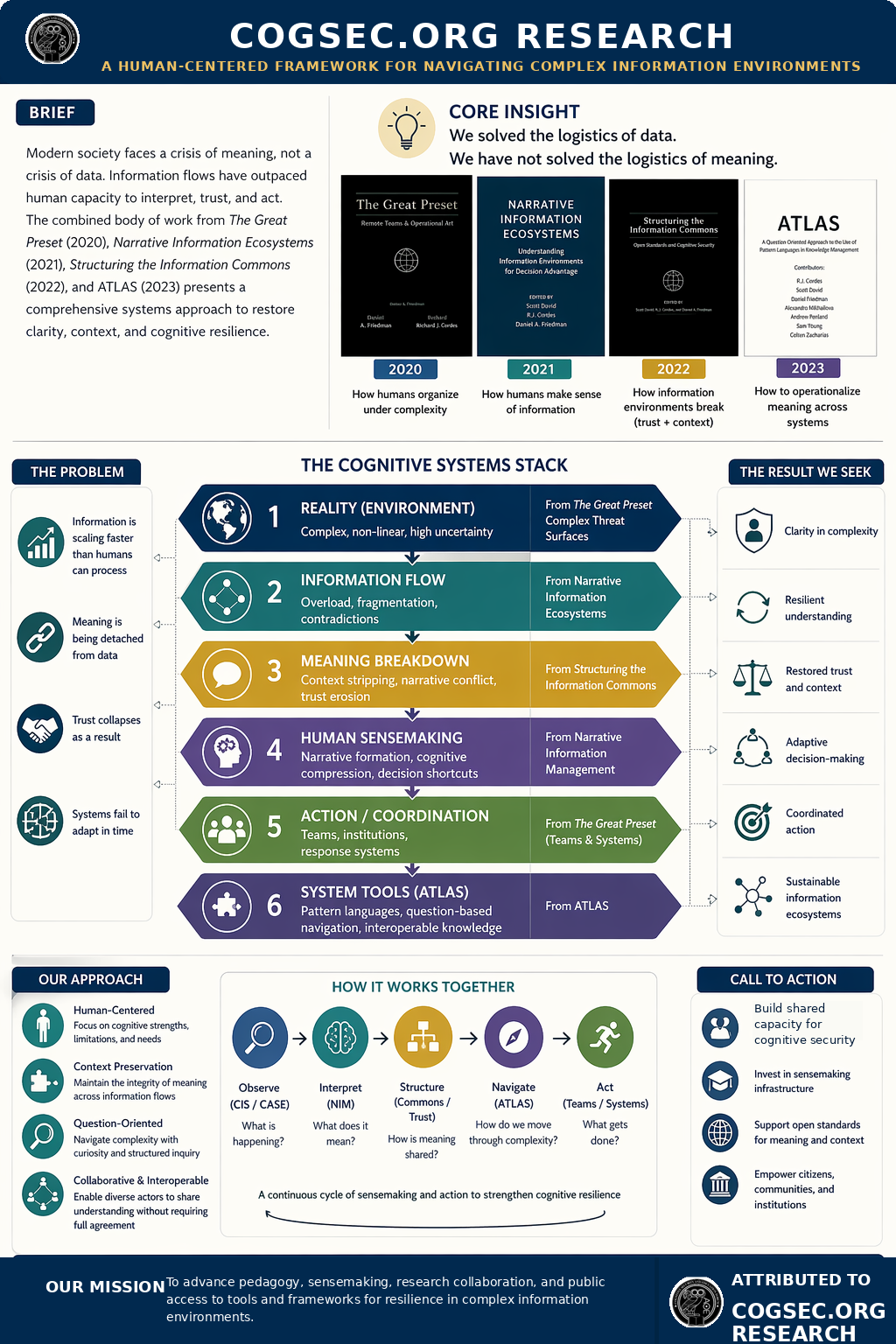
This infographic summarizes a progression of COGSEC.org research themes from remote teams and operational art, through narrative information ecosystems and structuring the information commons, to question-oriented knowledge management and framework interoperability.
These PDFs are provided for reference and should be reviewed in their original publication context, including licensing, disclaimers, author notes, and attribution requirements.
Remote teams and operational art, with emphasis on emergent teams, operational coordination, catechism-based project structures, and complex threat environments.
Open PDFResearch on narrative information management, conflict, trust, digital rhetorical ecosystem analysis, and sensemaking across complex information environments.
Open PDFOpen standards and cognitive security, with attention to context, meaning, information commons, verified information exchange environments, and trust in digital information transactions.
Open PDFA question-oriented approach to pattern languages in knowledge management, intended to support navigability, interoperability, and shared understanding in complex information supply chains.
Open PDFThe Properties, Processes, and Perspectives Inter-Framework, a modular approach to requirements engineering, information risk, and cognitive security across interdisciplinary decision systems.
Open PDF